
Core
SRC Alternatives: 7 PIM Solutions to Compare
Stephan Spijkers · 2026-10-11 · 9 min read
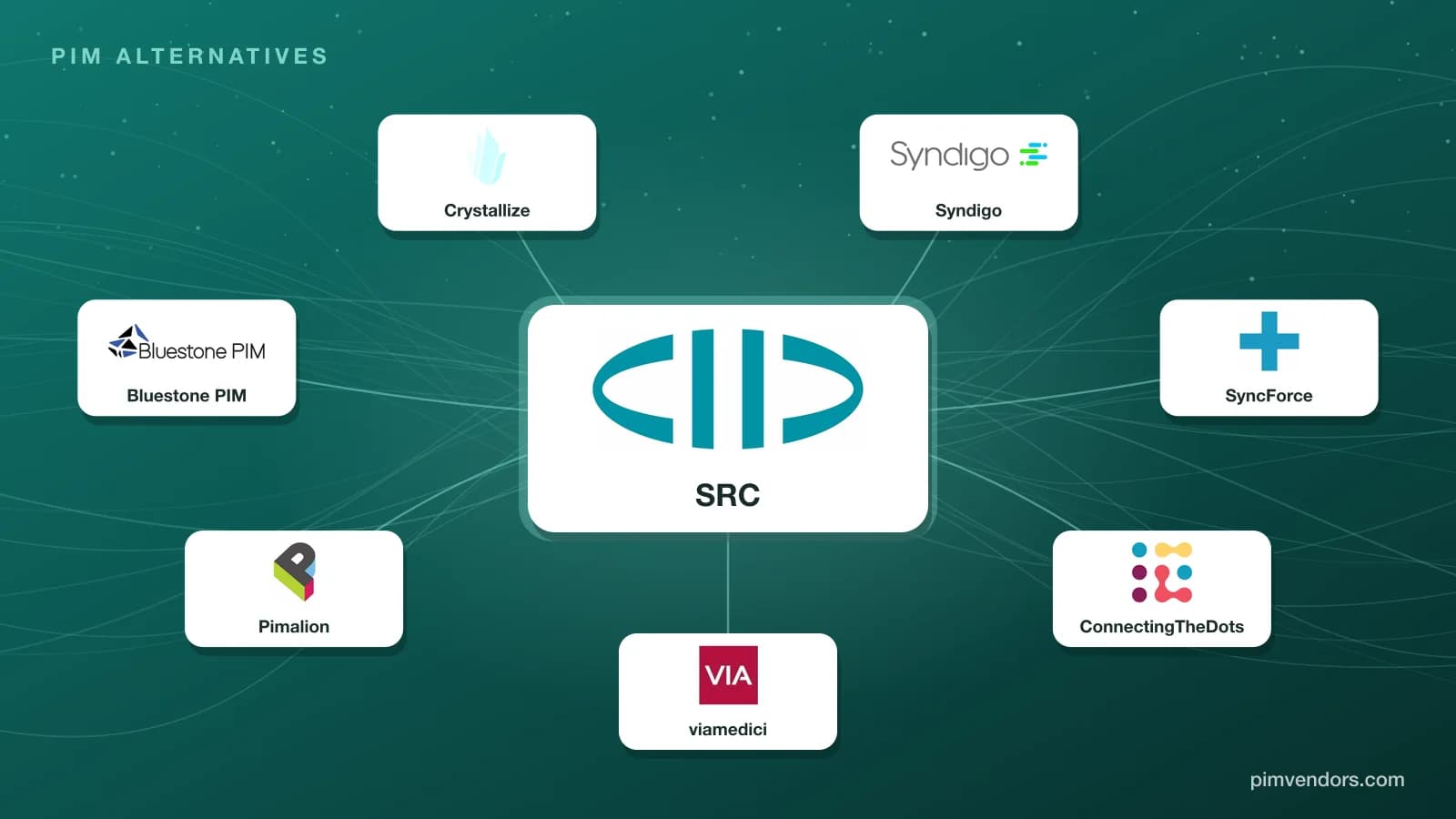
SRC is built for Benelux retailers and suppliers that exchange product data through standards and data pools. Teams that run it reopen the choice when their commerce strategy changes, when they expand beyond the Benelux, or when the change of ownership raises questions about the roadmap. This guide covers what SRC does, why teams look for an alternative, seven alternatives ordered by fit, and how to switch.
What SRC is and who it fits
SRC is a Dutch company with more than 20 years in product data, founded in 2000 according to our SRC profile. Its PIM is built around standards. The profile lists:
- Classification and taxonomy management: native support for ETIM, GS1 and UNSPSC.
- Supplier data onboarding: validating, cleaning and mapping incoming supplier data with configurable workflows.
- Data governance and quality control: rule-based validation, completeness checks and approval workflows.
- Syndication: export templates and connectors for retailers, marketplaces and catalogs.
- Localization and integration: multiple languages, plus an API for ERP, DAM, PLM and e-commerce systems.
Our analyst, Ronald Muller, places SRC with Benelux, and especially Dutch, retailers, wholesalers and suppliers whose requirements center on GDSN and GS1 sector compliance, ETIM and 2BA, PS in foodservice, supplier onboarding portals and data pool syndication. He names its long standards engineering heritage, integrated validation with maintained standard data models, a supplier portal used by Jumbo and references at Ahold and Intergamma, a native DAM for GS1 imagery and a REST API for updates as strengths. SRC runs as SaaS or cloud-hosted for mid-market and enterprise companies.
As we reported in November 2024, SRC System Integrators was sold to AGENA3000, a French company that builds data management software for PIM, EDI and ERP.
Why teams look for an SRC alternative
Each reason below comes from the watch-outs in the analyst assessment on the profile.
- Composable or direct-to-consumer commerce outside the Benelux. The analyst does not see SRC as a default pick for US or global direct-to-consumer commerce on a composable stack.
- Richer product experience content. Rich experience management for marketing is not where SRC's strength lies.
- Marketplace-native syndication. Syndication to Amazon and other marketplaces needs a proof of concept with SRC.
- Vendor scale and roadmap. The analyst names SRC's small vendor scale and uncertainty about how AGENA3000 will consolidate SRC's PIM with its own PDM and PIM products.
SRC alternatives at a glance
- Syndigo: best for enterprise suppliers and retailers that need GDSN and a large retailer network.
- SyncForce: best for larger packaged-goods manufacturers with packaging, regulatory and GS1 data pool needs.
- ConnectingTheDots: best for Benelux retailers and wholesalers with many, messy supplier feeds.
- Viamedici: best for SAP-centric manufacturers that need governed master data with ETIM and ECLASS.
- Pimalion: best for retailers that need product content, DAM and print publishing for marketing.
- Bluestone PIM: best for mid-market and enterprise teams that build a composable commerce stack.
- Crystallize: best for direct-to-consumer and B2B teams that build their own storefronts.
For technical wholesale where ETIM and 2BA are the main job, also compare Skwirrel and Gepard.
The alternatives
The fit and watch-out notes come from each vendor profile and its analyst assessment, where it has one.
Syndigo
Syndigo is a US platform that combines PIM, MDM and content syndication with a large retailer network, and operates GDSN itself rather than as an add-on. Our analyst places it with enterprise teams in consumer goods, foodservice, health and beauty, hardlines and retail vendor management, where retailer compliance, GDSN and enhanced content drive revenue. Its network story is strongest in North American grocery and retail after the 1WorldSync acquisition.
Check: which of your Benelux recipients and data pools it reaches today. Authoring and composable APIs are secondary to network compliance, and the content hub and the Riversand MDM are two integration surfaces. More in our Syndigo vs competitors.
SyncForce
SyncForce is a Dutch PIM for brand manufacturers, founded in 2005. Our analyst places it with larger packaged-goods manufacturers in food, pet, home and personal care and building or DIY, with complex trade hierarchies and GS1 data pool distribution in Europe. It has an evidenced GDSN connector with listed markets and pools, a model for product, packaging and logistics data and ISO 27001 certification. It fits the supplier side of SRC's market.
Check: the vendor's own FAQ says it is not for SMB, retail, fashion or automotive, and headless or composable buyers will hit read API and release constraints.
ConnectingTheDots
ConnectingTheDots is a Dutch SaaS PIM, founded in 2008. Our analyst places it with mid-market and enterprise Benelux retailers, wholesalers and multi-brand e-commerce with messy inbound supplier data, where fast catalog operations, channel-specific pricing and a vendor-close implementation matter, especially with Icecat, Onetrail or fashion supplier feeds. Automated supplier onboarding is its clearest strength, with credible Dutch enterprise references.
Check: GS1, GDSN and ETIM publication depend on the partner Qmica, so budget for it and for ongoing mapping. It is not an enterprise multidomain MDM.
Viamedici
Viamedici is a German vendor, founded in 1996, that sells MDM, PIM, DAM and product configuration as one enterprise suite, as SaaS, cloud-hosted or on-premise. Our analyst places it with SAP-centric manufacturers and industrial distributors that need governed master data outside SAP, ETIM and ECLASS depth and multi-language print and digital catalogs. It adds a multidomain MDM with golden record and a supplier portal.
Check: it is not a lean composable PIM, so budget for suite complexity and integrator cost. Evidence for GDSN and GS1 retail syndication is thin, which matters if that is why you chose SRC.
Pimalion
Pimalion is a Belgian PIM, founded in 2010, with DAM, a brand portal and automated print publishing in one modular suite, sold as SaaS or cloud-hosted. Its profile places it with mid-market and enterprise retailers, wholesalers and manufacturers in Europe whose marketing teams manage printed catalogs, e-commerce content, point-of-sale material and campaigns in several languages and brands. It addresses the experience and marketing content side that SRC's analyst notes as a gap.
Check: the profile gives no detailed analyst assessment, so test deployment effort, proof of standards support for GS1, GDSN and ETIM, and commercial terms.
Bluestone PIM
Bluestone PIM is a Norwegian SaaS PIM, founded in 2013, built on a microservice, API-first architecture and MACH-certified. It fits mid-market and enterprise manufacturers, distributors and omnichannel retailers with large catalogs, several markets or brands and a composable commerce stack. It is the option for a team that moves from a standards-first PIM to one that feeds a composable stack across markets.
Check: deployment effort, proof of standards support and commercial terms. Ask exactly how GDSN, GS1 sector models and ETIM are covered, and by whom.
Crystallize
Crystallize is a Norwegian headless commerce backend with PIM, founded in 2017, with a GraphQL API. It fits direct-to-consumer and B2B teams that want one composable backend for product content, subscriptions, multi-market pricing and their own storefronts, with engineers available.
Check: there is no native GDSN, ETIM or marketplace syndication. Those are SRC's core strengths, so Crystallize fits only when standards and data pools are no longer your main job, or when another tool keeps doing them.
How to choose and switch
Inventory the standards and connections
List every standard and version you use (GS1 sector models, ETIM, 2BA, PS in foodservice), every data pool and recipient, the supplier portal and its users, the EDI links and the exports. This shows which parts of SRC carry the value for you.
Decide who maintains the standards
Either the new vendor maintains the standard data models and validation, or a partner does, or your own team. This decision narrows the shortlist more than features do.
Shortlist three and demo with your own data
Give each vendor one real product group, one supplier file and one data pool submission. Ask them to show validation against the standard, not only the export.
Migrate in slices with a parallel run
Move one channel or one group of suppliers at a time, and compare what SRC and the new system send to each data pool until the output matches.
Settle the contract
Check renewal terms and notice periods, and model three to five years of subscription, partner connectors, data pool fees and services. Our PIM cost comparison gives ranges per segment.
Compare SRC alternatives side by side
Compare these and other systems in the PIM profile overview, or answer a few questions in the free PIM Scan for a ranked shortlist based on your scale, sector and must-haves.
- AGENA3000 acquires SRC System Integrators: what the deal means for Benelux buyers.
- Data pools and syndication round table: practitioners on GDSN and syndication.
- Top 10 PIM solutions for wholesale: the wider wholesale shortlist.
Where to go from here
Frequently asked questions
What is SRC PIM?
SRC is a Dutch PIM built around data standards, from a company founded in 2000. It manages product data for retailers, wholesalers and suppliers with native support for GS1, ETIM and UNSPSC, supplier data onboarding, validation and syndication to retailers, data pools and catalogs. It runs as SaaS or cloud-hosted, mainly in the Benelux.
Who owns SRC?
SRC System Integrators was sold to AGENA3000, a French company that builds data management software for PIM, EDI and ERP. Our news article on the deal covers what it means for Benelux customers. Ask which product you will be on in the long run, because AGENA3000 also has PIM and PDM products of its own.
What are the best SRC alternatives?
For GDSN and a retailer network, Syndigo. For packaged-goods manufacturers with GS1 data pools, SyncForce. For retailers and wholesalers with many supplier feeds, ConnectingTheDots. For SAP-centric enterprises, Viamedici. For retail marketing and print, Pimalion. For composable stacks, Bluestone PIM and Crystallize.
Does SRC support GDSN and ETIM?
Yes. Our profile lists native support for GS1, ETIM and UNSPSC, and our analyst places SRC with buyers whose requirements center on GDSN and GS1 sector compliance, ETIM and 2BA, PS in foodservice and data pool syndication. That is its core strength.
When is SRC still the right choice?
When you are a Benelux retailer, wholesaler or supplier and your requirements center on GDSN, GS1 sector standards, ETIM and 2BA, foodservice data, supplier portals and data pool syndication. Our analyst names its long standards heritage, maintained standard data models and supplier portal references as strengths.
How do you switch from SRC to another PIM?
List every standard, data pool, supplier portal and export you run, decide who will maintain the standard data models after the switch, test three systems with your own data, migrate one channel or supplier group at a time with a parallel run, and switch SRC off only when every data pool connection runs from the new system.
Diagnostic
Do you actually need a PIM?
Run the complexity index before you budget software or hire an SI.
Budget
Model a first-pass TCO
Translate catalog shape into a three-year cost range in under ten minutes.