
Core
Syndigo vs Competitors: An In-Depth Comparison
Stephan Spijkers · 2025-08-26 · Updated 2026-10-13 · 12 min read
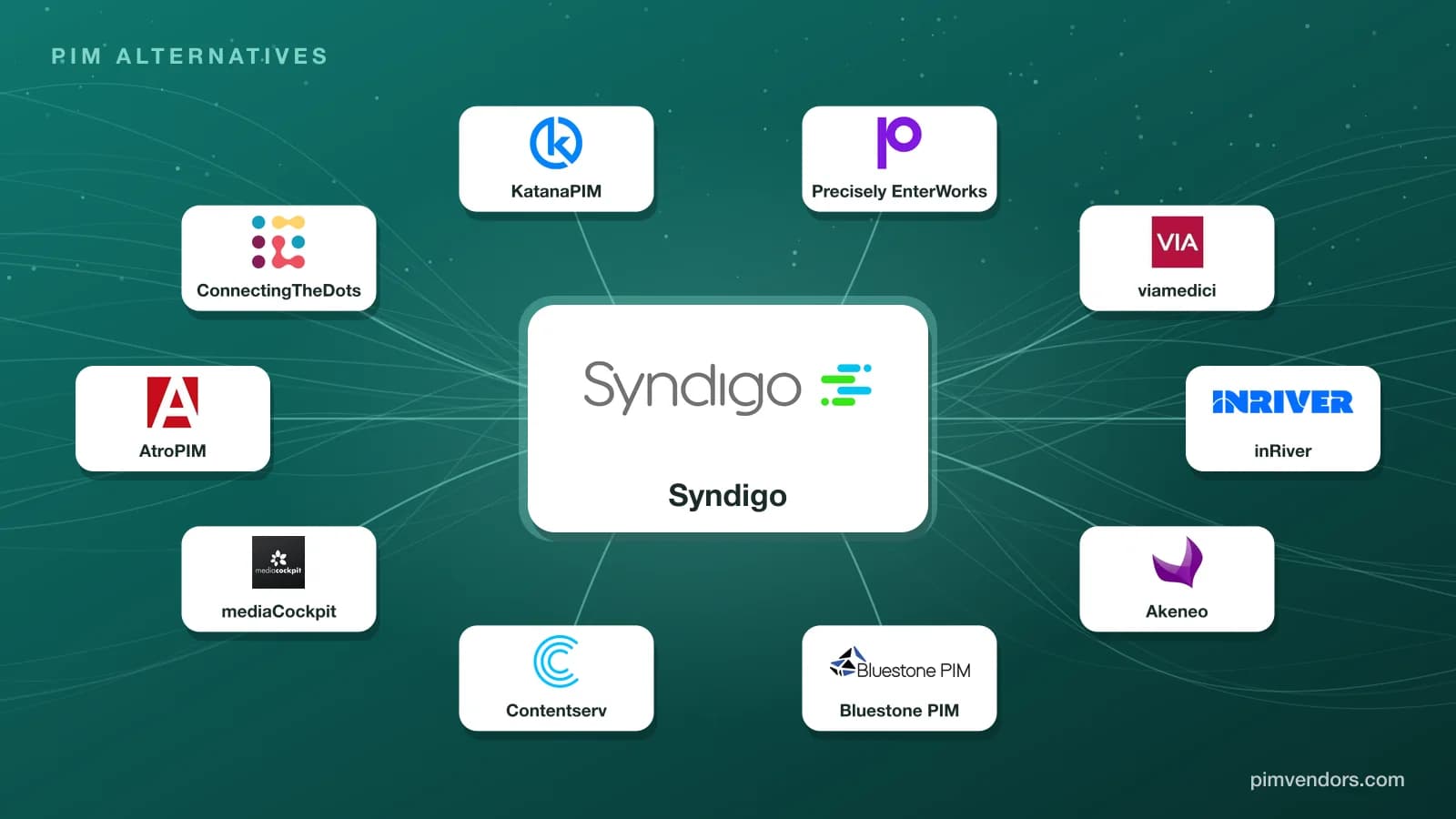
Syndigo shows up on enterprise shortlists wherever brands sell through large retailers, and its acquisitions of Riversand and 1WorldSync have changed the market around it. A buyer who compares Syndigo with "the competition" therefore has to start by deciding which competition is meant, because the alternatives range from other retailer networks to master data platforms and PIMs. This comparison covers what Syndigo is, how it grew, when an alternative fits better, and the main alternatives by segment. Fit and watch-out notes per vendor are on our vendor profiles.
What Syndigo is
Syndigo is a Chicago-based company that sells product content management and syndication to brands, manufacturers, distributors and retailers. Its platform combines PIM, MDM, digital asset management and syndication. Content is authored or imported, validated against each recipient's requirements and sent to retailers, marketplaces, distributors and data pools. Syndigo is also a certified GDSN data pool, so it exchanges GS1 product data directly.
A PIM: built around your record
Your product record Example
- Webshop
- Print catalog
- Marketplaces
A network: built around the recipients
- RetailersRetailer portal✓ Validated
- MarketplacesMarketplace API✓ Validated
- GDSN data poolsGDSN✓ Validated
- DistributorsFeed✓ Validated
Brand content Example
Decide which job you are hiring for: a retailer network, a master data platform, a PIM, or a PIM plus a feed tool.
That position is what separates Syndigo from a classic PIM. A PIM is built around your own product record and your own channels: you decide the data model, and the channels take what you publish. Syndigo is built around the recipients, the retailers and data pools that set rules for what they accept, and the platform's job is to make your content meet those rules. For a food manufacturer that supplies several large grocery chains, each with its own required attributes, image specifications and nutrition formats, that difference shapes most of the daily work. Syndigo's best fit is with enterprise teams in consumer packaged goods, foodservice, health and beauty, hardlines and retail vendor management, where retailer compliance, GDSN and enhanced product page content drive revenue. The Syndigo profile has the details.
How Syndigo grew
2018 to 2019
Gladson becomes Syndigo
Chicago-based Gladson, owned by The Jordan Company and Wicks Capital Partners, bought FSEnet, Webcollage, Nutritionix, ItemMaster and Edgenet, and brought them together under the Syndigo brand in early 2019, as Consumer Goods Technology reported. FSEnet brought a GDSN data pool, Webcollage the enhanced content shown on retailer product pages.
May 2021
Riversand adds master data management
On 27 May 2021 Syndigo announced the acquisition of Riversand, a cloud MDM and PIM vendor. Riversand gives Syndigo master data beyond the product domain, such as customer, vendor and location data.
September 2025
1WorldSync joins
On 3 September 2025 Syndigo announced it had acquired 1WorldSync, another large product content and GDSN network, together with the PowerReviews ratings and reviews business. Syndigo says the combined company serves more than 18,000 customers and reaches more than 3,500 retailers in 60 countries. Our news analysis covers what the deal changes.
When Syndigo fits, and when an alternative fits better
Syndigo's strengths are its syndication, validation and recipient network (especially for North American grocery and retail after 1WorldSync), the enhanced content heritage from Webcollage, digital shelf analytics in the suite, credible MDM matching and merging through Riversand, and GDSN as an operator rather than an add-on. Together they make it a strong candidate for a brand whose main problem is getting complete, compliant content to many retailers that each have their own requirements.
An alternative usually fits better when the network is not your main problem. A direct-to-consumer brand without retailer compliance pain is the clearest case: Syndigo is less suited as a first PIM there, because much of what it does well serves recipients that brand does not have. The same goes for a team that mainly needs authoring and a flexible product record. Syndigo is not a classic PIM, and authoring and composable commerce APIs are secondary to network compliance, so a team that builds its own storefronts and wants to model products its own way is usually better served by a PIM-first platform.
Architecture is another reason. If you want one integration surface, keep in mind that the content hub and the Riversand MDM are two, so an architecture review is part of any Syndigo evaluation. Size matters too: Syndigo's best fit is large brands and retailers, and our PIM Scan treats it as an enterprise option, so a mid-market company is often better served by a PIM built for its scale. Finally, the merger timeline can be a reason to look further. Platform consolidation after 1WorldSync is still a question to ask about, and if you need certainty about the platform for the coming years, get the answer in writing.
How to compare Syndigo with its competitors
Decide which job you are hiring for
Decide first whether you need a retailer network, a master data platform, a PIM, or a PIM plus a feed tool. Syndigo's competitors differ most on this point, so a comparison without that decision compares the wrong things. Salsify and Stibo Systems, for example, answer different questions, and a feature checklist puts them side by side as if they did not.
List the recipients you must reach
Write down every retailer, marketplace, distributor and data pool you send content to, and how each one receives it: GDSN, a retailer portal, a marketplace API or a feed. Ask every vendor which of them it reaches today, and how. The list often shows quickly whether you need a network platform at all, or whether a PIM with a data pool subscription covers your recipients.
Test authoring with your own data
Give each vendor one real product family, including enhanced content and two recipients with different rules. Let the people who maintain product content score the authoring and validation work, because they will notice whether a rejected item comes back with a clear reason or only an error code.
Review the integration architecture
Map how the platform connects to your ERP, DAM and existing PIM, and how many integration surfaces you end up with. This step matters most when MDM is in scope, because master data for customers, suppliers and locations usually touches more systems than product content does.
Model three to five years of cost
Add up the subscription, connectors, data pool fees, services and the time of your internal team over the full period, because the first-year price says little about the total. Our PIM cost comparison gives ranges per segment.
Syndigo alternatives by segment
The map below places each alternative by segment. The sections after it describe each vendor briefly, with what to check before you put it on a shortlist.












| Alternatives to Syndigo | Built for | Industry | Runs as | Founded | Go-live (estimate) |
|---|---|---|---|---|---|
| Today: Syndigo | Mid-market, Enterprise | Retail, Manufacturing | SaaS, Cloud-hosted | 1973 | 20 weeks |
| Salsify | Mid-market, Enterprise | Retail, Manufacturing | SaaS | 2012 | No estimate yet |
| Stibo Systems | Enterprise | Retail, Manufacturing, Wholesale | SaaS, Cloud-hosted, On-premise | 1976 | 20 weeks |
| Precisely EnterWorks | Enterprise | Manufacturing, Wholesale | SaaS, Cloud-hosted, On-premise | 1968 | 20 weeks |
| Viamedici | Mid-market, Enterprise | Manufacturing, Wholesale | SaaS, Cloud-hosted, On-premise | 1999 | 20 weeks |
| inRiver | Mid-market, Enterprise | Manufacturing, Retail, Wholesale | SaaS, Cloud-hosted | 2007 | 20 weeks |
| Akeneo | Small business, Mid-market, Enterprise | Retail, Wholesale | SaaS, Open source, Cloud-hosted | 2013 | 16 weeks |
| Bluestone PIM | Mid-market, Enterprise | Retail, Manufacturing | SaaS, Cloud-hosted | 2016 | 20 weeks |
| Contentserv | Mid-market, Enterprise | Manufacturing, Retail | SaaS, Cloud-hosted, On-premise | 2000 | 20 weeks |
| mediacockpit | Mid-market, Enterprise | Manufacturing, Retail | SaaS, Cloud-hosted, On-premise | 1996 | 20 weeks |
| AtroPIM | Small business, Mid-market | Manufacturing, Wholesale | SaaS, Open source, On-premise, Cloud-hosted | 2020 | 8 weeks |
| ConnectingTheDots | Mid-market, Enterprise | Retail, Wholesale | SaaS, Cloud-hosted | 2008 | 8 weeks |
| KatanaPIM | Small business, Mid-market, Enterprise | Retail, Wholesale | SaaS | 2017 | 16 weeks |
| Ergonode | Small business, Mid-market, Enterprise | Retail | SaaS, Cloud-hosted | 2018 | 16 weeks |
| Crystallize | Small business, Mid-market, Enterprise | Retail | SaaS, Cloud-hosted | 2017 | 16 weeks |
Enterprise: network and master data
These vendors compete with Syndigo for large organizations, either on retailer syndication or on governed master data. Which of them belongs on your list depends on whether your problem sits with the recipients or with your own master data.
Salsify. Salsify is a Boston-based product experience platform, founded in 2012, aimed at brands that sell through retailers and marketplaces. It is the closest like-for-like alternative for brand-side syndication. In August 2026 the investor Cinven agreed to acquire Salsify, so ask about the roadmap. Compare recipient coverage for your own retailers. See our Salsify alternatives.
Stibo Systems. Stibo Systems is a Danish vendor, founded in 1976, whose STEP platform is multidomain MDM with PIM and GDSN.
- Choose it when you need a multidomain golden record, product governance, GDSN or retailer sync, complex hierarchies and an ERP-centric landscape.
- Check cost and duration, and whether the job is really lightweight enrichment, where STEP may be the wrong tool. More in our Stibo alternatives.
Precisely EnterWorks. Precisely EnterWorks is a US MDM, PIM and DAM platform for large manufacturers, distributors and B2B catalog operators.
- Choose it when you need governed multidomain MDM, a native DAM, supplier portals, print plus digital publishing and GDSN, especially in an SAP-centric landscape.
- Check the total cost: pricing is quote-only and implementation often dominates it. Precisely EnterWorks profile.
Viamedici. Viamedici is a German vendor, founded in 1999, that sells MDM, PIM, DAM and a product configurator as one suite to large manufacturers and industrial distributors, as SaaS, cloud-hosted or on-premise.
- Choose it when you run SAP, sell complex configurable products, produce print and digital catalogs in several languages, and need ETIM or ECLASS and a governed golden record with a supplier portal outside SAP.
- Check suite complexity and integrator cost, because it is not a lean composable PIM. Evidence for GDSN and GS1 retail syndication is thin, so it does not replace a retailer network. Viamedici profile.
Enterprise and mid-market: PIM first
These vendors start from the product record and add syndication on top. They suit buyers whose main need is authoring and a flexible data model, and who can reach retailers through partners or data pools where needed.
inRiver. inRiver is a Swedish SaaS PIM with syndication and digital shelf analytics as first-class features, plus print and PDF from the same model. Pricing is quote-only with indexed renewals, and GS1 and ETIM often run through partners. inRiver profile.
Akeneo. Akeneo is a French API-first PIM with completeness and quality tooling, supplier data onboarding and a DAM, sold as SaaS; it is sunsetting its Community Edition. It does not replace a multidomain MDM, and GS1 support needs proof in a proof of concept. Akeneo profile.
Bluestone PIM. Bluestone PIM is a Norwegian SaaS PIM on a microservice, API-first architecture for composable stacks. Evaluate it on deployment effort, standards support and commercial terms, and if retailer syndication is in scope, ask how your GS1 or GDSN requirements would be met. Bluestone PIM profile.
Contentserv. Contentserv is a German PIM and DAM with supplier onboarding, a golden record approach for product data and high-volume feed syndication, including a GDSN model for food and beverage. Centric Software announced in February 2025 that it would acquire Contentserv, so ask about the roadmap. Contentserv profile.
Mid-market
The mid-market options below lean toward manufacturers and wholesalers: two of them support technical standards such as ETIM in depth, and the third is built around supplier onboarding. For all three, GDSN runs through a partner or needs verifying, so check how retail syndication would work for your recipients.
mediacockpit. mediacockpit is a German PIM, DAM and publishing system with deep ETIM and ECLASS support, print through InDesign and GDSN through a partner. Marketplace syndication is narrower than in feed-first tools. mediacockpit profile.
AtroPIM. AtroPIM is a German open-source (GPLv3) PIM and master data hub, also available as SaaS, with deep configurability and modules for ETIM and BMEcat. It suits teams with developers or a trusted integrator. Verify GDSN before you treat it as a retail option. AtroPIM profile.
ConnectingTheDots. ConnectingTheDots is a Dutch SaaS PIM with automated supplier onboarding as its clearest strength. GS1, GDSN and ETIM publication run through a partner. ConnectingTheDots profile.
Smaller teams
For smaller teams the question is usually whether a retailer network platform is needed at all. A SaaS PIM with published pricing, combined with a data pool or feed tool where a recipient requires one, often covers the same ground at a scale that fits.
KatanaPIM. KatanaPIM is a Dutch SaaS PIM with published pricing and the API on every plan, for small and mid-market merchants. GS1 and GDSN run through partner middleware. KatanaPIM profile.
Ergonode. Ergonode is a Polish SaaS PIM with a well-liked enrichment interface, API and headless delivery, a DAM included and published pricing. It is not GS1-native. Ergonode profile.
Crystallize. Crystallize is a Norwegian headless commerce backend with PIM, for direct-to-consumer and B2B teams that build their own storefronts and have engineers available. It has no native GDSN, ETIM or marketplace syndication. Crystallize profile.
If you mainly need channel feeds
Feed management and syndication tools such as Productsup take product data from your PIM, ERP or shop and map it to each channel's format. They do not hold the master record. Combined with a PIM, they cover marketplaces and shopping channels without a network platform, which suits a brand that sells mainly through marketplaces and its own webshop. Retailers that require GDSN still need a data pool, so check your recipient list before you settle on this route.
Related guides
- Best PIM software: the wider market overview.
- Salsify alternatives and Stibo alternatives: the other enterprise comparisons.
- What PXM stands for: product experience management, the category Syndigo and Salsify sell in.
- Data pools and syndication round table: practitioners on GDSN and syndication.
Where to go from here
Frequently asked questions
What is Syndigo?
Syndigo is a Chicago-based software company that combines PIM, MDM and content syndication with a network of retailers and other recipients. Brands, manufacturers and retailers use it to author product content, validate it against each recipient's requirements and send it out. It grew through acquisitions, including Riversand in 2021 and 1WorldSync in 2025.
Who are Syndigo's main competitors?
For brands that sell through retailers, Salsify is the closest like-for-like competitor. For multidomain master data, Stibo Systems and Precisely EnterWorks. For PIM-first buyers, inRiver, Akeneo, Bluestone and Contentserv. For channel feeds alone, feed management tools such as Productsup. 1WorldSync used to compete with Syndigo and is now part of it.
What is the best Syndigo alternative for an enterprise?
It depends on what you use Syndigo for. If the retailer network and GDSN matter most, compare Salsify and Stibo Systems. If you need multidomain MDM, compare Stibo Systems and Precisely EnterWorks. If authoring and composable APIs matter more than the network, compare inRiver, Akeneo and Bluestone.
What is the difference between Syndigo and Salsify?
Both sell product content management and syndication to brands that sell through retailers and marketplaces. Syndigo adds MDM through Riversand, operates a GDSN data pool and, since buying 1WorldSync, a larger retailer network. Salsify started as a brand-side PIM and grew into a product experience platform. Compare them on the recipients you need to reach and on authoring for your own team.
Akeneo vs Syndigo, which one fits?
Akeneo is PIM-first: an API-first product record with enrichment, quality and supplier onboarding tools, sold as SaaS now that it is sunsetting its Community Edition. Syndigo is network-first: validation and syndication to retailer requirements, GDSN and enhanced content, with PIM and MDM around it. Heavy retailer compliance points to Syndigo; a flexible record for your own channels points to Akeneo.
Productsup vs Syndigo, what is the difference?
Productsup is a feed management and syndication platform. It takes product data from your PIM, ERP or shop and transforms it into the formats channels and marketplaces ask for, but it does not aim to be the master product record. Syndigo combines the record, validation and a retailer network. Some companies run a PIM plus a feed tool instead of one network platform.
What happened to Riversand and 1WorldSync?
Syndigo announced the acquisition of Riversand, a cloud MDM and PIM vendor, on 27 May 2021, and of 1WorldSync, a product content and GDSN network, on 3 September 2025. Riversand now provides Syndigo's MDM. 1WorldSync's network and its PowerReviews ratings and reviews business are part of Syndigo.
Is there a cheaper alternative to Syndigo for a smaller company?
Smaller teams rarely need a retailer network platform. A SaaS PIM with published pricing, such as KatanaPIM or Ergonode, plus a data pool subscription or a feed tool for the recipients that require one, often covers the need. First check which retailers require GDSN or specific content formats from you, because that list decides how much network you actually need.
Diagnostic
Do you actually need a PIM?
Run the complexity index before you budget software or hire an SI.
Budget
Model a first-pass TCO
Translate catalog shape into a three-year cost range in under ten minutes.