
Core
Epitomy Alternatives: 7 PIM Solutions to Compare
Stephan Spijkers · 2026-10-11 · 9 min read
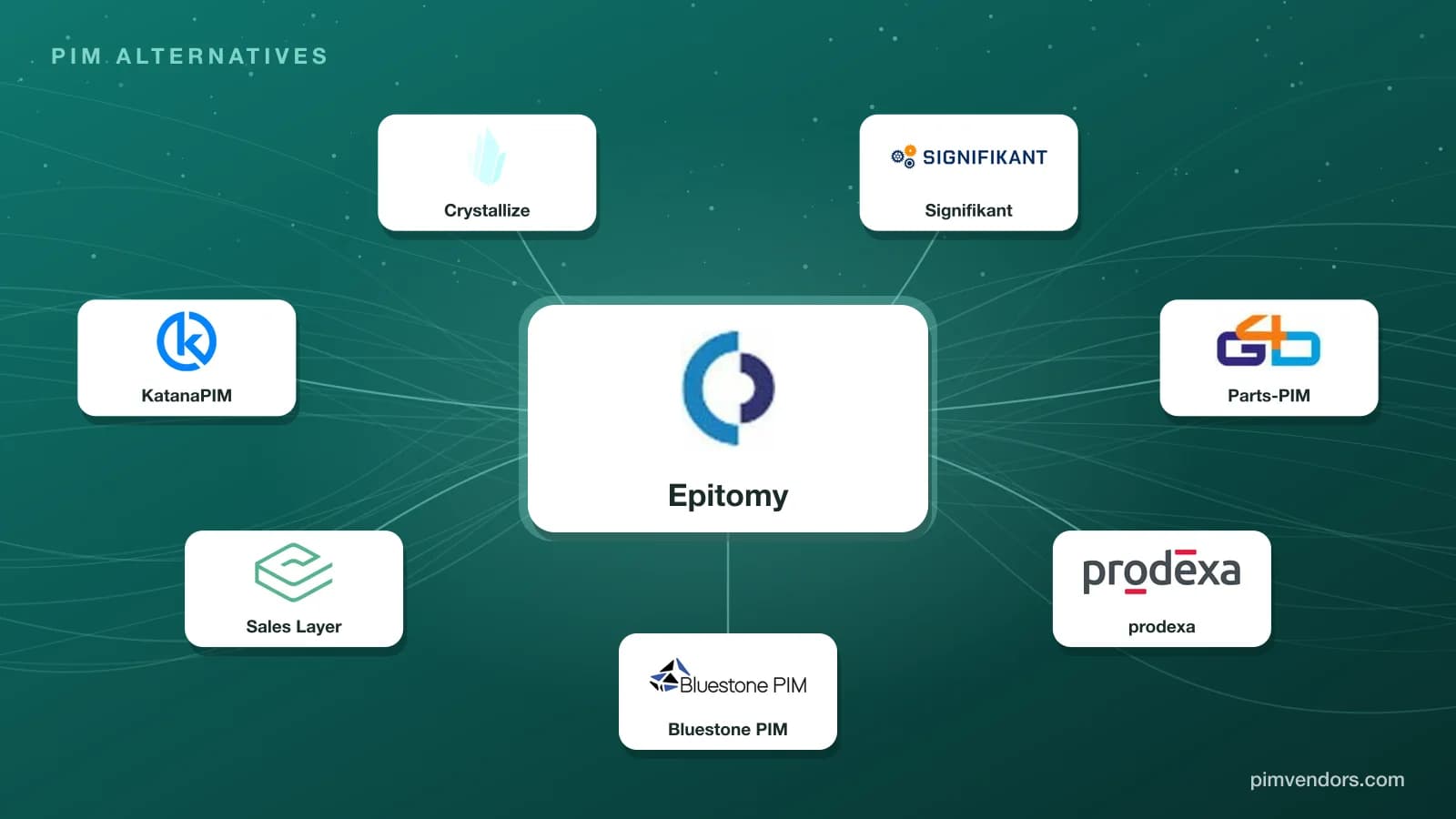
Epitomy serves a specific corner of the PIM market: spare parts and the aftermarket for complex capital goods. Teams that use it look at alternatives when their scope grows, when their dealer network crosses borders, or when a contract comes up for renewal. This guide covers what Epitomy does, why teams look elsewhere, seven alternatives ordered by fit, and how to switch.
What Epitomy is and who it fits
Epitomy is a UK company, founded in 2000. According to our Epitomy profile, it sells product information management to manufacturers and distributors of complex capital goods in the automotive and industrial aftermarket. The platform collects technical product data, spare parts information and illustrated documentation into one repository with secure online access, and combines PIM with electronic parts catalogues, dealer portals and e-commerce.
The profile names three groups of users: aftermarket teams and parts catalogue managers who maintain illustrated spare parts publications, dealer network administrators who give dealers parts lookup and ordering through branded portals, and technical teams who link CAD systems for hotspotted illustrations and exploded views. It runs as SaaS or cloud-hosted, under a proprietary licence, for small and mid-market companies.
That combination is what you compare against. A general PIM covers the data on the left and the webshop on the right. The illustrated catalogue, the hotspots on drawings and the dealer portal are the parts that a general PIM usually does not do on its own.
The profile does not give an analyst assessment or a capability list for Epitomy. Ask for a demo with your own parts data and for references in your sector.
Why teams look for an Epitomy alternative
- You need a PIM for more than the aftermarket. Epitomy's profile is built around parts data and catalogue publication. If marketing content for your full range, marketplaces or many sales channels are now in scope, a general PIM may have to sit next to it or replace it.
- Your dealers are outside the UK. The profile lists activity in the UK. Teams with dealer networks in several countries check languages, hosting and support in each market.
- You need on-premise deployment. Epitomy is listed as SaaS or cloud-hosted.
- You want more evidence. Without an analyst assessment or capability list in the profile, a comparison with two or three other systems is the way to test what you get.
- You outgrow the scale. The profile lists small and mid-market companies. Larger OEMs with global service networks can compare platforms built for mid-market and enterprise scale.
Epitomy alternatives at a glance
- Signifikant: best for OEMs that need a deep aftermarket parts model, illustrated catalogues and dealer and technician portals.
- Parts-PIM: best for technical distributors and spare parts suppliers in the Benelux that need precise parts data.
- prodexa: best for DACH and EU manufacturers with variants, bills of materials, ETIM or ECLASS, and automotive aftermarket data.
- Bluestone PIM: best for mid-market and enterprise manufacturers with complex product relationships and a composable stack.
- Sales Layer: best for mid-market manufacturers that want one marketer-friendly PIM for shops and marketplaces.
- KatanaPIM: best for Benelux distributors with specification-heavy catalogs on Magento, Shopify or Shopware.
- Crystallize: best for teams with engineers that want to build their own dealer portal or parts shop.
The alternatives
The fit and watch-out notes come from each vendor profile and its analyst assessment, where it has one.
Signifikant
Signifikant is a Swedish aftermarket platform, founded in 1995, sold cloud-hosted or on-premise. It is the closest like-for-like alternative. Our analyst places it with manufacturers and OEMs where aftermarket revenue and uptime depend on accurate spare parts identification, service documentation and dealer and technician portals, with optional parts e-commerce, especially in heavy equipment, industrial machinery and long-lifecycle capital goods. Its parts model covers kits, supersession, the step from engineering to service bill of materials and filtering by machine or serial number, with an illustrated catalogue, a web viewer and offline use.
Check: custom ERP integration and the operating burden of an on-premise install, including sizing for PDF publishing. It is the wrong tool for retail PIM, GS1, GDSN, ETIM or marketplace syndication.
Parts-PIM
Parts-PIM is a SaaS PIM from the Benelux, founded in 2016, for technical distributors, spare parts suppliers and industrial manufacturers in automotive, machinery and industrial equipment. Its profile describes structured models for technical classifications, compatibility and dimensions, aimed at fewer errors in parts ordering. It fits teams whose main job is precise parts data for technical buyers.
Check: the profile gives no analyst assessment and does not describe illustrated catalogues or dealer portals, so ask whether those are covered or need another tool. It lists activity in the Benelux only.
prodexa
prodexa is a German PIM and product experience suite, founded in 2019 by teams from OpusCapita and jCatalog, sold as SaaS or cloud-hosted. Our analyst places it with DACH and EU manufacturers and distributors that need ETIM or ECLASS, supplier catalog onboarding, print and catalog publishing or automotive aftermarket data through TecDoc. Its strengths include a deep model for variants, bills of materials and pricing, an export engine with a print path and published entry pricing for the SaaS edition.
Check: it is not a safe pick for API-first or composable setups unless you accept the documented API limits, and GDSN and digital product passport support need a proof of concept.
Bluestone PIM
Bluestone PIM is a Norwegian SaaS PIM, founded in 2013, built on a microservice, API-first architecture and MACH-certified. Its profile describes support for complex product relationships, variants, bundles and configurable products in large catalogs, with validation, completeness scoring and workflows. It fits mid-market and enterprise manufacturers and distributors that want one product record feeding a composable stack, with the parts catalogue as a separate component.
Check: deployment effort, proof of standards support and commercial terms. Illustrated parts catalogues and dealer portals are not part of the profile, so plan where they live.
Sales Layer
Sales Layer is a Spanish SaaS PIM, founded in 2013. Our analyst places it with mid-market manufacturers, brands, distributors and B2B suppliers that want a fast, marketer-friendly PIM, connectivity to Amazon, Google and Shopify, quality scoring and, optionally, Ariba punchout for procurement customers. It fits a manufacturer that wants one PIM for its full range and sales channels, next to a parts catalogue.
Check: GS1 and GDSN run through a partner at extra cost, the API works with polling and rate limits, and the profile does not describe parts catalogue features.
KatanaPIM
KatanaPIM is a Dutch SaaS PIM, founded in 2018. Our analyst places it with mid-market Benelux and EU merchants, wholesalers and distributors on Magento, Shopify or Shopware with Exact or a similar ERP, who need a usable PIM for catalogs with many variants and specifications. Pricing per tier is published and the API is on every plan. It fits a parts distributor whose main channel is a webshop.
Check: ETIM, GS1 and GDSN run through partner middleware, native AI is largely absent, and the profile does not describe illustrated catalogues or dealer portals.
Crystallize
Crystallize is a Norwegian headless commerce backend with PIM, founded in 2017, with a GraphQL API. Our analyst notes flexible product modeling, including configurator and bill-of-materials patterns, and a strong API for reading and writing data. It fits B2B teams with engineers who want to build their own dealer portal or parts shop on one composable backend.
Check: it is not a pure PIM for catalog operations centered on the ERP, and it has no native ETIM or marketplace syndication. The illustrated catalogue and hotspots would be your own build.
How to choose and switch
Inventory what Epitomy does for you
List the parts data, illustrations and hotspots, the publications you produce, the dealer portal users and ordering flows, the CAD links and the systems that feed parts data in.
Decide: specialist or PIM plus catalogue
Either replace Epitomy with another aftermarket specialist, or split the job into a general PIM for product data and a separate tool or build for the illustrated catalogue and dealer portal. This decision sets the shortlist.
Shortlist three and demo with your own data
Give each vendor the parts list and drawings of one real machine or model, including supersessions. Let a parts catalogue manager and a dealer score the lookup and ordering.
Migrate one product line at a time
Move one product line, compare the new catalogue with the old one part by part, and keep dealers on the existing portal until the new one is verified.
Settle the contract
Check your notice period and your rights to export data and illustrations, and model three years of subscription, services and hosting. Our PIM cost comparison gives ranges per segment.
Compare Epitomy alternatives side by side
Compare these and other systems in the PIM profile overview, or answer a few questions in the free PIM Scan for a ranked shortlist based on your scale, sector and must-haves.
- Optimizing aftermarket service delivery with PIM: how PIM supports parts and service.
- Top 10 PIM solutions for manufacturing: the wider manufacturing shortlist.
Where to go from here
Frequently asked questions
What is Epitomy?
Epitomy is a UK software company, founded in 2000, that sells product information management for the aftermarket. It brings technical product data, spare parts information and illustrated documentation into one repository, and publishes it as electronic parts catalogues, dealer portals and parts e-commerce. It runs as SaaS or cloud-hosted.
Who uses Epitomy?
Manufacturers and distributors of machinery, vehicles and industrial equipment, in sectors such as automotive, marine and construction equipment. Inside those companies, aftermarket teams, technical documentation specialists, parts catalogue managers and dealer network administrators work with it.
What are the best Epitomy alternatives?
For a like-for-like aftermarket specialist, compare Signifikant, and Parts-PIM for technical parts data. For technical catalogs with automotive or bill-of-materials depth, prodexa. For a general PIM next to a parts catalogue, Bluestone PIM, Sales Layer and KatanaPIM. For a custom dealer portal built by your own engineers, Crystallize.
What is an electronic parts catalogue?
An online catalogue that links exploded-view drawings to part numbers, so dealers, technicians and customers can find the right spare part and often order it directly. Epitomy's profile describes this as hotspotted illustrations with search, linked to dealer ordering.
Can a general PIM replace Epitomy?
Only partly. A general PIM can hold the parts data and send it to a webshop or dealers. Illustrated parts catalogues, hotspots on drawings and parts lookup for dealers usually need an aftermarket specialist, a separate catalogue tool or a custom build next to the PIM.
Is Epitomy available outside the UK?
Our profile lists Epitomy as active in the UK. If your dealers work in other countries, ask about languages, hosting, support hours and references in those markets before you decide.
How do you switch away from Epitomy?
Inventory the parts data, illustrations, hotspots, publications and dealer ordering flows, decide between an aftermarket specialist and a general PIM plus a catalogue tool, test three systems with one real product line, migrate one product line at a time with a parallel run, and move dealers over last.
Diagnostic
Do you actually need a PIM?
Run the complexity index before you budget software or hire an SI.
Budget
Model a first-pass TCO
Translate catalog shape into a three-year cost range in under ten minutes.