
Core
Best Akeneo Alternatives in 2026: PIM Platforms Compared
Stephan Spijkers · 2025-04-18 · Updated 2026-11-07 · 20 min read
Last updated: 7 November 2026.
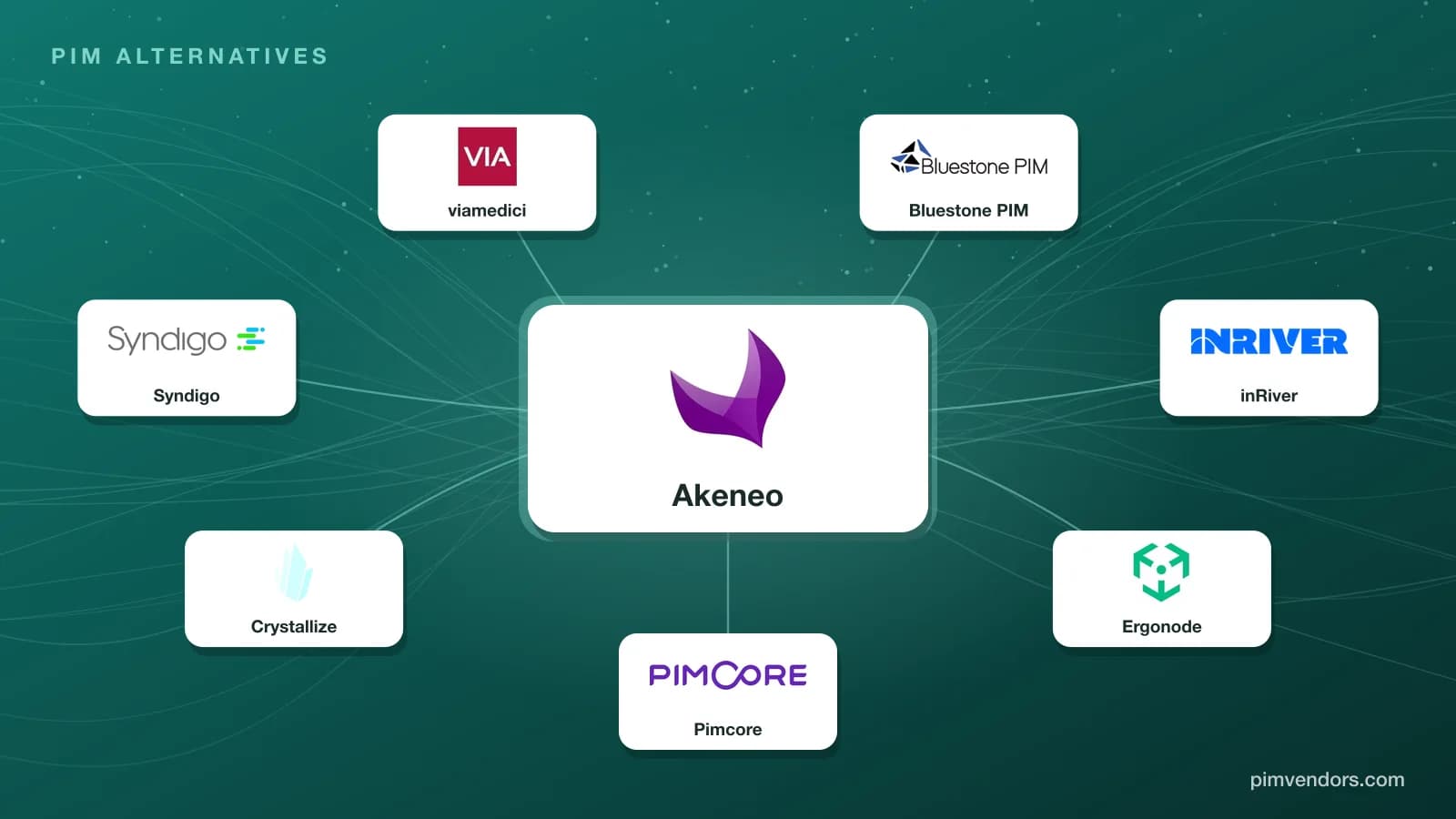
The best Akeneo alternative in 2026 depends on why you are leaving. If price is the reason, Plytix, Ergonode and AtroPIM publish their prices and have free or low entry plans. If you want open source or self-hosting, Pimcore and AtroPIM are the closest options. If your scope has grown into governance and master data, Stibo Systems and Viamedici are built for it. If retailer syndication and GDSN drive revenue, Salsify and Syndigo run their own networks. If you sell mainly through Shopify, Plytix and Sales Layer have apps in the Shopify App Store. And if you are leaving because you heard the Community Edition is ending: Akeneo says it is not.
This guide compares 14 alternatives in one table, explains what is and is not changing with Akeneo Community Edition, groups the alternatives by reason for leaving and then covers each one: what it is, how it differs from Akeneo and what to check. It ends with how to switch without losing data.
Which Akeneo alternatives are worth a look in 2026?
The table lists 14 alternatives. Pricing is marked as published only when the vendor shows prices on its own pricing page; "quote" means it does not. Open source means the vendor offers an edition under an open source or open core licence, as named by the vendor. Deployment follows our vendor profiles. As of 7 November 2026.
| Vendor | Best for | Deployment | Pricing published | Open source |
|---|---|---|---|---|
| Plytix | Small and mid-market brands that want a low-cost, collaborative PIM | SaaS | Yes, free Standard plan; Pro from €149/month at 100 SKUs (pricing) | No |
| Ergonode | Mid-market teams that want a usable enrichment interface, an included DAM and published pricing | SaaS | Yes, free plan; Advance from €5,990/year (pricing) | Code released under OSL 3.0, but its public backend repository has been archived since 2023 |
| AtroPIM | Teams with developers that want a configurable, self-hosted PIM and master data hub | Self-hosted or SaaS | Yes, free Open-Source Edition; SaaS from €400/month (pricing) | Yes, Open-Source Edition |
| Pimcore | Teams that want one platform for product data, assets and content, self-hosted if needed | On-premise, cloud or PaaS | Yes, Community free under conditions; Professional $9,900/year (pricing) | Open core, under the Pimcore Open Core License (POCL) |
| Crystallize | DTC and B2B teams with engineers that want product, content and commerce in one headless backend | SaaS | Yes, free tier for testing; Atom $949/month plus usage (pricing) | No |
| Salsify | Consumer goods brands selling through many retailers | SaaS | No, quote (pricing) | No |
| inriver | Manufacturers and brands with many channels, print and shelf analytics | SaaS on Microsoft Azure | No, quote (plans) | No |
| Sales Layer | Marketing-led mid-market teams that want fast onboarding and ready connectors | SaaS | No, quote; plan limits published (pricing) | No |
| Pimberly | Mid-sized and large retailers, distributors and manufacturers that want PIM and DAM in one | Cloud on AWS | Not checked | No |
| Bluestone PIM | Composable, API-first commerce stacks with complex catalogs | SaaS | No, usage-based quote (pricing) | No |
| Syndigo | Brands where retailer compliance, GDSN and enhanced content drive revenue | SaaS | No, quote | No |
| Stibo Systems | Global enterprises that need multidomain MDM and product governance | SaaS, cloud-hosted or on-premise | No, quote | No |
| Viamedici | SAP-centric manufacturers that need MDM, PIM, DAM and a configurator | SaaS, cloud-hosted or on-premise | No, quote | No |
| Centric PXM | European mid-market and enterprise brands that want PIM, DAM, syndication and shelf analytics from one vendor | SaaS, cloud-hosted or on-premise | No, quote | No |
Prices are the vendors' published entry points in the vendors' own currency, before VAT, on the date above. They exclude implementation, connectors and your own team, which often cost more than the licence in the first year. For Akeneo's own editions, see Akeneo vs Salsify vs inriver pricing.











| Alternatives to Akeneo | Built for | Industry | Runs as | Founded | Go-live (estimate) |
|---|---|---|---|---|---|
| Today: Akeneo | Small business, Mid-market, Enterprise | Retail, Wholesale | SaaS, Open source, Cloud-hosted | 2013 | 16 weeks |
| Plytix | Small business, Mid-market | Retail | SaaS | 2015 | No estimate yet |
| Ergonode | Small business, Mid-market, Enterprise | Retail | SaaS, Cloud-hosted | 2018 | 16 weeks |
| AtroPIM | Small business, Mid-market | Manufacturing, Wholesale | SaaS, Open source, On-premise, Cloud-hosted | 2020 | 8 weeks |
| Pimcore | Small business, Mid-market, Enterprise | Manufacturing, Retail | Open source, Cloud-hosted, On-premise | 2009 | 16 weeks |
| Crystallize | Small business, Mid-market, Enterprise | Retail | SaaS, Cloud-hosted | 2017 | 16 weeks |
| Salsify | Mid-market, Enterprise | Retail, Manufacturing | SaaS | 2012 | No estimate yet |
| inriver | Mid-market, Enterprise | Manufacturing, Retail, Wholesale | SaaS, Cloud-hosted | 2007 | 20 weeks |
| Sales Layer | Small business, Mid-market, Enterprise | Manufacturing, Retail, Wholesale | SaaS | 2013 | 16 weeks |
| Pimberly | Mid-market, Enterprise | Retail, Manufacturing | SaaS, Cloud-hosted | 2015 | 20 weeks |
| Bluestone PIM | Mid-market, Enterprise | Retail, Manufacturing | SaaS, Cloud-hosted | 2016 | 20 weeks |
| Syndigo | Mid-market, Enterprise | Retail, Manufacturing | SaaS, Cloud-hosted | 1973 | 20 weeks |
| Stibo Systems | Enterprise | Retail, Manufacturing, Wholesale | SaaS, Cloud-hosted, On-premise | 1976 | 20 weeks |
| Viamedici | Mid-market, Enterprise | Manufacturing, Wholesale | SaaS, Cloud-hosted, On-premise | 1999 | 20 weeks |
| Centric PXM | Mid-market, Enterprise | Manufacturing, Retail | SaaS, Cloud-hosted, On-premise | 2000 | 20 weeks |
The map places Akeneo and each alternative by the company size it is built for and by industry. Start from the row for your own industry to see which options keep you in similar territory and which move you toward a suite, a network or a commerce backend.
What is changing with Akeneo Community Edition?
Less than many pages claim. Akeneo's own Community Edition page states that no end-of-life has been announced for the Community Edition, and that the 30 September 2026 end-of-support date applied to version 7.0, not to the Community Edition (Akeneo, checked 7 November 2026). Akeneo's support-dates page says the same: its table covers only the PaaS and on-premise editions, and the Community Edition "is continuously being supported" (Akeneo Help Center, checked 7 November 2026).
What did change is the release model. After version 7.0, released on 8 March 2023, the Community Edition moved to calendar versioning (vYYYY.Minor). The releases listed on Akeneo's GitHub repository include 2026.3 (30 March 2026), 2026.4 (28 August 2026) and 2026.5 (30 October 2026) (GitHub). Akeneo says these releases do not guarantee backward compatibility, so you check the changelog before every upgrade, and users on 6.0 first move to 7.0.
Three practical consequences follow:
- If you self-host the Community Edition, there is no deadline from Akeneo forcing you off it. You do need to keep upgrading to receive security and bug fixes, and each upgrade is a small project because compatibility is not guaranteed.
- If you run Akeneo's PaaS (Flexibility) or on-premise edition on version 7.0, support ended on 30 September 2026 according to Akeneo's table. Talk to Akeneo about your path, and compare that offer with the alternatives below.
- If a vendor tells you the Community Edition is ending, ask for Akeneo's source. Several competitors and partners have published that claim; Akeneo's own pages contradict it.
We compare the self-hosted options in AtroPIM vs Pimcore vs Akeneo Community Edition.
Why do teams leave Akeneo, and why do many stay?
Akeneo is a French PIM vendor, founded in 2013, with a free self-hosted Community Edition next to its paid SaaS Product Cloud. Akeneo lists three Product Cloud packages: Growth, shown as starting at $0 with a free trial, and Advanced and Premium on quote (Akeneo, checked 7 November 2026). Its core strengths fall into five areas:
- Product modeling with families, variants and enrichment completeness.
- Data quality tooling, with completeness scoring and quality insights.
- Supplier onboarding through Supplier Data Manager, with a portal, mapping and AI extraction.
- A native DAM in Product Cloud, focused on product assets rather than a full brand DAM.
- Localization across many locales for companies that sell in several countries.
Teams leave for a few recurring reasons:
- The job grew into master data management. Akeneo is not a substitute for multidomain MDM. If customer, supplier or location data must share a governed golden record with products, you need an MDM platform next to or instead of a PIM.
- Standards. GS1, ETIM and digital product passport support need explicit proof and often run through a partner. Industrial manufacturers whose wholesalers require ETIM, and suppliers that must publish through a data pool, tend to compare systems where this is part of the product.
- Price and edition. A renewal, a move from the Community Edition to a paid edition, or the end of support for version 7.0 on PaaS or on-premise reopens the budget question.
- The retailer network is the real problem. Brands whose revenue depends on retailer compliance, GDSN and enhanced content often need a network platform more than a better product record.
- Architecture. Some digital-native teams want product data, content and commerce logic in one headless backend, or one self-hosted platform for product data, assets and website content.
And many stay. Akeneo remains a strong choice when the job is multichannel product content: enrichment, completeness, localization and supplier onboarding in an API-first or composable stack, with a large partner and app ecosystem around it. If none of the reasons above applies to you, negotiate the renewal instead. A PIM migration costs time and money that only a real gap justifies.
Which alternative fits your reason for leaving?
| Your reason for leaving | Look first at | Why |
|---|---|---|
| Cost: you want a lower or more predictable price | Plytix, Ergonode, AtroPIM | Published prices with free or low entry plans |
| Open source or self-hosting | Pimcore, AtroPIM | Open core or open source editions you can host yourself |
| Governance and multidomain MDM | Stibo Systems, Viamedici | Golden record and governance beyond the product domain |
| Retailer syndication and GDSN | Salsify, Syndigo | Own syndication networks and certified GDSN data pools |
| Many channels, print and shelf analytics from one model | inriver, Centric PXM | Syndication, print and digital shelf features in the platform |
| Shopify-first brand | Plytix, Sales Layer | Apps in the Shopify App Store; see our Shopify PIM comparison |
| Composable enterprise stack | Bluestone PIM | API-only, microservices, MACH certified |
| Headless commerce with PIM built in | Crystallize | Product, content and commerce in one backend |
| Large multi-category catalogs with PIM and DAM in one | Pimberly | Cloud PIM and DAM for retailers, distributors and manufacturers |
The alternatives
Each section covers what the system is, how it compares with Akeneo and what to check before it goes on your shortlist. Founding years, headquarters, fit and watch-outs come from our vendor profiles.
Plytix
Plytix is a SaaS PIM, founded in 2015, for small and mid-market brands, retailers and manufacturers that want a collaborative PIM without enterprise complexity. It brings product data into one hub, gives product and marketing teams a shared space to enrich and approve content, and publishes to webshops and marketplaces, with a feed management module for channel output.
- Best for: cost-conscious teams leaving Akeneo's paid editions, and Shopify-first brands.
- How it differs: a published price list with a free Standard plan and paid plans priced by SKU count, against Akeneo's quote-based editions above Growth.
- Check: how the price develops as your SKU count grows, and whether the data model handles your deepest product families. Compare in our Akeneo vs Plytix page.
Ergonode
Ergonode is a Polish SaaS PIM, founded in 2018, for mid-market digital brands and retailers that need a usable enrichment interface, API and headless delivery and an included product DAM.
- Best for: Akeneo's mid-market buyers who want a simpler commercial model.
- How it differs: pricing is published, with a free plan for 1,000 products and 2 users, and the DAM is part of the product.
- Check: enterprise MDM and native GS1 support are not proven, and the maturity of the supplier portal is unclear. Its open source backend repository has been archived since February 2023, so treat Ergonode as SaaS, not as a self-hosting option.
AtroPIM
AtroPIM is a German open-source PIM and master data hub, also sold as SaaS, that runs on-premise or in the cloud. Much of its data model, fields, layouts and API can be configured without code, it includes a DAM, and modules add ETIM and BMEcat.
- Best for: teams with developers or a trusted integrator that want to self-host, the closest fit for Community Edition users who want to keep that way of working.
- How it differs: a free Open-Source Edition and a published module and support price list.
- Check: which features need paid modules, and who maintains your instance. Our AtroPIM alternatives page covers its limits.
Pimcore
Pimcore is an Austrian open-core platform, founded in 2009, that combines product data, digital assets and content in one data layer, with modules toward MDM and commerce. It runs on-premise, cloud-hosted or as PaaS.
- Best for: teams that want one extensible platform for more than product data, with full control over hosting.
- How it differs: Pimcore states that all editions use the Pimcore Open Core License (POCL) for the core, and that the Community Edition is free for non-production use, academic and non-profit use, and companies with annual revenue under 5 million euros or dollars (Pimcore, checked 7 November 2026). Its ETIM and ECLASS classification is credible for industrial companies.
- Check: above the revenue threshold you need a paid edition, and you need a technical team or integrator. See what Tenzing buying Pimcore changes and Akeneo vs Pimcore.
Crystallize
Crystallize is a Norwegian headless commerce backend with PIM, founded in 2017, for small and mid-market teams. It combines product data, content and commerce, with a GraphQL API, native subscriptions and multi-market pricing.
- Best for: DTC and B2B teams that build their own storefronts.
- How it differs: PIM is co-equal with CMS and commerce, and the base pricing tiers are published.
- Check: it needs engineering capacity and has no native GDSN, ETIM or marketplace syndication. If your Akeneo setup feeds marketplaces today, that work needs another home.
Salsify
Salsify is a product experience management platform, founded in 2012, that helps brands and manufacturers centralize product data and rich media and syndicate it to retailers, distributors and digital channels. GS1 lists it as a certified GDSN data pool. In 2026 the investor Cinven agreed to acquire Salsify (our analysis).
- Best for: consumer goods brands and manufacturers that sell through many retailers and need content tuned per retailer.
- How it differs: network-first, where Akeneo is record-first.
- Check: references with your retailers and catalog size, and the roadmap after the Cinven deal. Compare in Akeneo vs Salsify.
inriver
inriver is a Swedish SaaS PIM on Microsoft Azure, founded in 2007, for mid-market and enterprise manufacturers, brands and wholesalers with complex catalogs.
- Best for: companies with many channels and marketplaces that want print and digital shelf analytics from one model.
- How it differs: syndication and digital shelf analytics are first-class features, and print comes from the same model as the digital channels.
- Check: pricing is quote-only with customizable plans, so model three to five years of cost. GS1, GDSN and ETIM are often partner extensions, as they are for Akeneo. Compare in Akeneo vs inriver and our inriver alternatives.
Sales Layer
Sales Layer is a Spanish SaaS PIM, founded in 2013, known for an interface that marketing teams can run, quick onboarding and prebuilt connectors to Shopify, Magento, Amazon and other channels.
- Best for: mid-market manufacturers, brands, distributors and B2B suppliers that want a fast, marketer-friendly PIM.
- How it differs: prebuilt channel connectors and a 30-day free trial; the pricing page shows plan limits for users, SKUs and languages, with prices on quote.
- Check: GS1 and GDSN come through a partner, and its API is not built for a composable, event-driven stack.
Pimberly
Pimberly is a UK cloud PIM and DAM, founded in 2015 and built on AWS, for mid-sized and large retailers, distributors and manufacturers in B2B and B2C.
- Best for: large, multi-category catalogs with localized content and many websites, marketplaces and partners.
- How it differs: PIM and DAM in one product, with connectors for the main commerce platforms, ERPs and marketplaces.
- Check: ask for deployment effort, standards proof and commercial terms. Compare in Akeneo vs Pimberly.
Bluestone PIM
Bluestone PIM is a Norwegian SaaS PIM, founded in 2016, built on microservices with an API-only architecture and MACH certification.
- Best for: mid-market and enterprise manufacturers, distributors and omnichannel retailers in a composable commerce stack.
- How it differs: three-level product families, bundles with quantities and a native DAM with a CDN. Its price model is usage-based, on users, SKUs and languages.
- Check: deployment effort, proof of standards support and implementation partners in your country. It is a PIM and does not replace a multidomain MDM.
Syndigo
Syndigo is a US platform that combines PIM, MDM through Riversand, DAM and content syndication with a network of retailers. GS1 lists it as a certified GDSN data pool, and it acquired 1WorldSync in 2025.
- Best for: enterprise teams in consumer goods, foodservice, health and beauty and hardlines, where retailer compliance drives revenue.
- How it differs: a network, where Akeneo is a product record.
- Check: the content hub and the Riversand MDM are two integration surfaces, so plan an architecture review. Compare in Akeneo vs Syndigo and Syndigo vs competitors.
Stibo Systems
Stibo Systems is a Danish vendor, founded in 1976, whose STEP platform is multidomain MDM with PIM for the product domain, sold as SaaS, cloud-hosted or on-premise to large enterprises.
- Best for: global enterprises that need a multidomain golden record and product governance, often with GDSN or retailer synchronization and an IT setup built around the ERP.
- How it differs: governance and master data depth that Akeneo does not aim for.
- Check: cost and project duration are the main watch-outs, and STEP is the wrong tool if the job is lightweight enrichment. Compare in Akeneo vs Stibo Systems.
Viamedici
Viamedici is a German enterprise suite, founded in 1999, that combines PIM, multidomain MDM with a golden record and supplier portal, DAM, and an integrated configurator and CPQ.
- Best for: SAP-centric manufacturers and industrial distributors with complex configurable products, especially in DACH.
- How it differs: governed master data outside SAP, ETIM and ECLASS classification, and print and digital catalogs from one system.
- Check: it is not a lean composable PIM, so budget for suite complexity and integrator cost. Evidence for GDSN and GS1 retail syndication is thin.
Centric PXM
Centric PXM is Centric Software's product experience management suite. Centric Software, the PLM vendor owned by Dassault Systèmes, acquired Contentserv in 2025, and Centric PXM now comprises the former Contentserv PIM and DAM plus syndication and digital shelf analytics.
- Best for: European mid-market and enterprise brands and manufacturers that want PIM, DAM, syndication and shelf analytics from one vendor.
- How it differs: syndication and digital shelf analytics in the suite, where Akeneo relies on its Activation offer and partners.
- Check: ask about the roadmap, the product name in the contract and support continuity after the acquisition. Compare in Akeneo vs Centric PXM.
How to switch without losing data
Write down why you are leaving
Name the gap: cost, MDM scope, standards, hosting, retailer network or commerce architecture. Each gap points to a different part of this list, using the table above. If none applies, negotiate the renewal instead.
Turn the gap into requirements
List the families, attributes, locales, channels, integrations and supplier flows you run in Akeneo today, and mark which ones must work on day one. Include the awkward cases, such as products with many variants or locales that are only partly translated. The PIM RFP guide helps turn this into questions for vendors.
Shortlist three and demo with your own data
Give each vendor one real product family with variants, assets and two channels. Let the people who enrich products every day score the work, and ask for proof of every standard you need.
Rehearse the migration and reconcile
Export families, attributes, options and assets with codes, not labels, because Akeneo exports with labels cannot be re-imported. Map the data model attribute by attribute, run at least two full rehearsal migrations and reconcile counts and values per attribute after each one. Our PIM-to-PIM migration guide has the checklist and the reconciliation table.
Time the contract
Check the notice period of your Akeneo subscription, keep Akeneo read-only until every channel runs from the new system, and compare the cost of the new system over three to five years, including connectors, services and the parallel run.
How we evaluated
We started from the vendors that buyers and AI answers name as Akeneo alternatives in 2026. For each vendor we opened its own pricing page and, where relevant, its edition or licence documentation on 7 November 2026, and recorded whether prices are published, the lowest published entry price and the licence the vendor names. Best-for lines, founding years, deployment and watch-outs come from our vendor profiles, which are built from the vendors' own material and our selection work. Facts about Akeneo Community Edition come only from Akeneo's own website, help center and GitHub repository. We did not use competitors' claims about Akeneo, several of which state that the Community Edition is ending, which Akeneo's own pages contradict.
We left out some names that appear in AI answers on this topic. WisePIM, Apimio and Productsup appear less often and were not researched in this pass. Hypotenuse and Atamya appear because they publish their own Akeneo alternatives articles. We did not open Pimberly's pricing page, so its pricing cell says not checked.
PIMvendors is an independent PIM selection platform. The table order groups vendors that publish prices first and is not a ranking. Prices and editions change, so confirm them with the vendor before you sign.
Sources
- Akeneo, Akeneo PIM Community Edition, checked 7 November 2026.
- Akeneo Help Center, Akeneo PIM product support dates, checked 7 November 2026.
- Akeneo Help Center, PIM version 7.0, checked 7 November 2026.
- Akeneo, pim-community-dev releases on GitHub, checked 7 November 2026.
- Akeneo, Compare packages, checked 7 November 2026.
- Plytix, Plytix pricing, checked 7 November 2026.
- Ergonode, Pricing, and backend repository on GitHub, checked 7 November 2026.
- AtroPIM, Pricing, checked 7 November 2026.
- Pimcore, Pricing and Pimcore editions, checked 7 November 2026.
- Crystallize, Pricing, checked 7 November 2026.
- Salsify, Pricing, checked 7 November 2026.
- inriver, PIM plans, checked 7 November 2026.
- Sales Layer, Pricing, checked 7 November 2026.
- Bluestone PIM, Pricing, checked 7 November 2026.
- GS1, Certified data pools list, checked 7 November 2026.
Compare more systems
Compare these and other systems in the PIM profile overview, or get a free shortlist based on your scale, sector and must-haves with the PIM Scan.
- Open source PIM compared: Pimcore, AtroPIM and other open options side by side.
- PIM costs compared: what a PIM costs per segment.
- How to select the right PIM: the full selection method.
Where to go from here
Frequently asked questions
What are the best Akeneo alternatives in 2026?
It depends on why you are leaving. On price, look at Plytix, Ergonode and AtroPIM, which publish their prices. For open source or self-hosting, Pimcore and AtroPIM. For enterprise governance and master data, Stibo Systems and Viamedici. For retailer syndication and GDSN, Salsify and Syndigo. For a composable enterprise stack, Bluestone PIM. For many channels plus print, inriver. For a Shopify-first brand, Plytix or Sales Layer.
Is Akeneo Community Edition being discontinued?
No, according to Akeneo. Its Community Edition page states that no end-of-life has been announced, and that the end-of-support date of 30 September 2026 applied to version 7.0, not to the Community Edition. New releases follow calendar versioning, the latest being 2026.5 of 30 October 2026, and Akeneo says releases do not guarantee backward compatibility. The support dates for version 7.0 apply to Akeneo's PaaS and on-premise editions.
Is there a free Akeneo alternative?
Yes, several, each with limits. Pimcore Community Edition is free under the Pimcore Open Core License for companies with annual revenue under 5 million euros or dollars. AtroPIM has a free Open-Source Edition you host yourself. Ergonode has a free plan for 1,000 products and 2 users, and Plytix has a free Standard plan. Akeneo's own Community Edition is also still free and self-hosted.
Which Akeneo alternative is cheapest?
Among the vendors in this guide that publish prices, the lowest paid entry points on 7 November 2026 were Plytix Pro at €149 per month for 100 SKUs and AtroPIM SaaS from €400 per month, followed by Ergonode Advance from €5,990 per year. Pimcore Professional is listed at $9,900 per year. Most enterprise alternatives are quote-only, so compare total cost over three to five years, not the entry price.
Who are Akeneo's main competitors?
In PIM-first selections Akeneo usually meets inriver, Salsify, Pimcore, Plytix, Sales Layer, Pimberly and Bluestone PIM. When the scope grows into master data or retailer networks, it meets Stibo Systems, Viamedici, Syndigo and Centric PXM.
Akeneo vs Salsify, what is the difference?
Akeneo is a PIM first: a flexible product record with enrichment, completeness and supplier onboarding. Salsify calls itself a product experience management platform and puts syndication to retailers first, including its own certified GDSN data pool. Retailer compliance points to Salsify, a product record for your own channels points to Akeneo.
When is Akeneo still the right choice?
When the job is multichannel product content: enrichment, completeness, localization and supplier onboarding in an API-first or composable stack. It is less suited when you need multidomain MDM, native GS1 or ETIM support, or a retailer network.
How do you migrate away from Akeneo?
Write down why you are leaving, export families, attributes, options and assets with codes rather than labels, demo three systems with your own data, rehearse the migration and reconcile every attribute, and switch Akeneo off only when every channel runs from the new system and the notice period allows it. Our PIM-to-PIM migration guide covers each step.
Diagnostic
Do you actually need a PIM?
Run the complexity index before you budget software or hire an SI.
Budget
Model a first-pass TCO
Translate catalog shape into a three-year cost range in under ten minutes.